
PPWR in 90 DAYS
YOUR SESSION NOTES
We have pulled all of our recommendations, best practices, and key takeaways from the session into one place. Use this as your go-to reference as you work through your own PPWR compliance process, and share it with anyone on your team who needs it.
We have pulled all of our recommendations, best practices, and key takeaways from the session into one place. Use this as your go-to reference as you work through your own PPWR compliance process, and share it with anyone on your team who needs it.
We have pulled all of our recommendations, best practices, and key takeaways from the session into one place. Use this as your go-to reference as you work through your own PPWR compliance process, and share it with anyone on your team who needs it.
Unlock PPWR insights
Our PPWR content is created with great care and a practical focus.
To prevent copying and AI training, we ask for your email address for longer articles. After clicking the confirmation link, this page will refresh and activate the content directly at this URL.
You are currently viewing a placeholder content from Mailjet. To access the actual content, click the button below. Please note that doing so will share data with third-party providers.
More InformationUnlock PPWR insights
Our PPWR content is created with great care and a practical focus.
To prevent copying and AI training, we ask for your email address for longer articles. After clicking the confirmation link, this page will refresh and activate the content directly at this URL.
You are currently viewing a placeholder content from Mailjet. To access the actual content, click the button below. Please note that doing so will share data with third-party providers.
More InformationUnlock PPWR insights
Our PPWR content is created with great care and a practical focus.
To prevent copying and AI training, we ask for your email address for longer articles. After clicking the confirmation link, this page will refresh and activate the content directly at this URL.
You are currently viewing a placeholder content from Mailjet. To access the actual content, click the button below. Please note that doing so will share data with third-party providers.
More InformationWhat’s PPWR?
The EU Packaging and Packaging Waste Regulation (Regulation (EU) 2025/40) replaces 27 separate national laws with one set of rules that apply directly across all EU Member States.

It covers the full packaging lifecycle, from design to end-of-life, for both B2B and B2C packaging.

It affects any business in the supply chain of packaged goods on the EU market, from raw materials to consumer goods.

The regulation applies from August 12, 2026, but rolls out in phased milestones all the way to 2040.
What’s PPWR?
The EU Packaging and Packaging Waste Regulation (Regulation (EU) 2025/40) replaces 27 separate national laws with one set of rules that apply directly across all EU Member States.
It covers the full packaging lifecycle, from design to end-of-life, for both B2B and B2C packaging.
It affects any business in the supply chain of packaged goods on the EU market, from raw materials to consumer goods.
The regulation applies from August 12, 2026, but rolls out in phased milestones all the way to 2040.
What’s PPWR?
The EU Packaging and Packaging Waste Regulation (Regulation (EU) 2025/40) replaces 27 separate national laws with one set of rules that apply directly across all EU Member States.
It covers the full packaging lifecycle, from design to end-of-life, for both B2B and B2C packaging.
It affects any business in the supply chain of packaged goods on the EU market, from raw materials to consumer goods.
The regulation applies from August 12, 2026, but rolls out in phased milestones all the way to 2040.
Your
PPWR Glossary

Component
An individual part of a packaging unit. For example: bottle, cap, label, or shrink wrap.
Packaging Unit
All components together as placed on the market. Bottle + cap + label = one packaging unit.
Sales Packaging
The packaging designed to be the final sales unit for the end user.
Grouped Packaging
Packaging that groups multiple sales units together at the point of sale. Example: a six-pack carrier.
Transport Packaging
Packaging used to move goods through the supply chain. Pallets, outer cardboard boxes. Typically unbranded.

The PPWR Milestones at a Glance
Meet Deadlines. Avoid Market Bans. Avoid Fines.
The PPWR Milestones at a Glance
Meet Deadlines. Avoid Market Bans. Avoid Fines.
the PPWR Milestones at a Glance
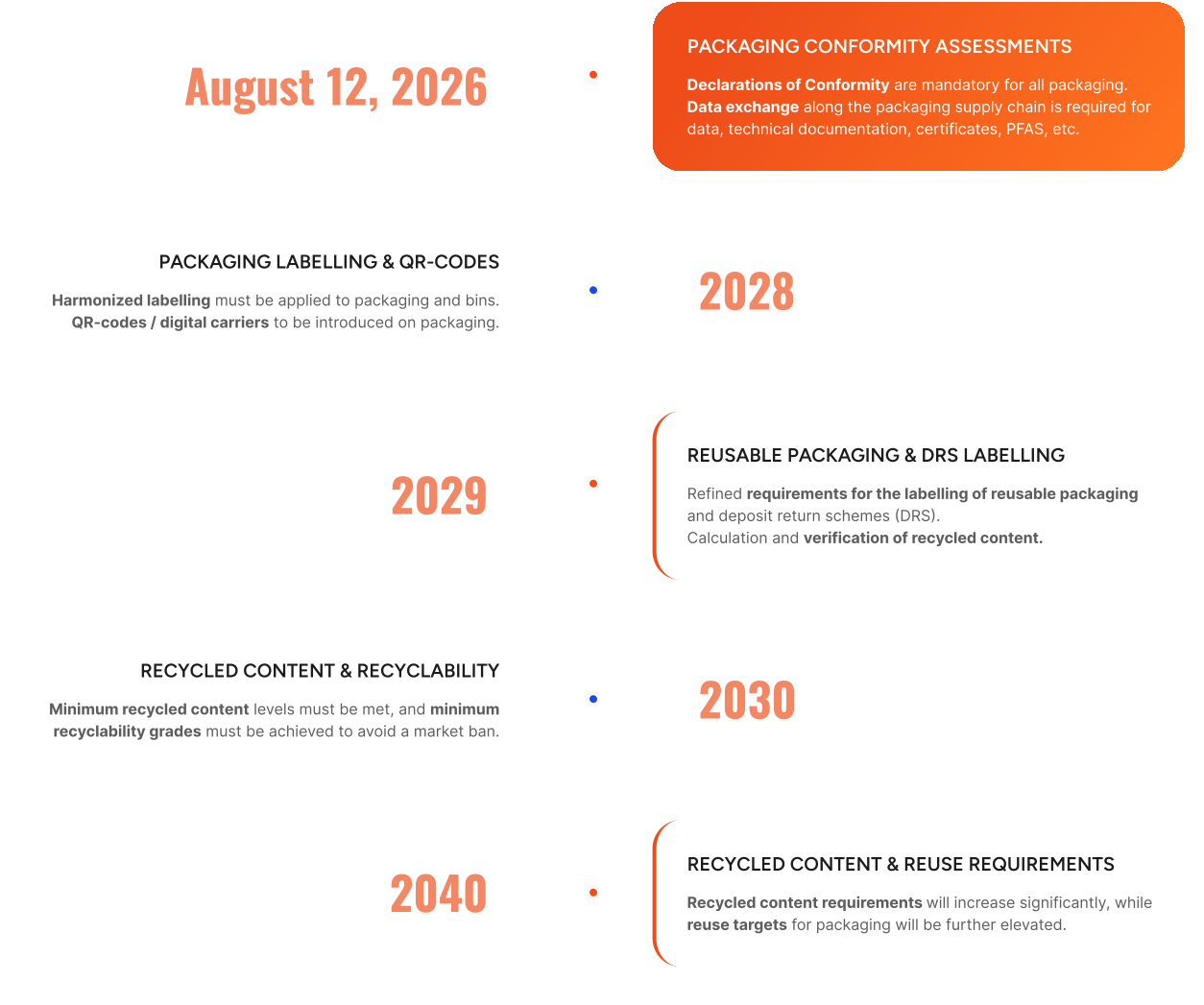
August 12, 2026
PACKAGING CONFORMITY
ASSEsSMENTS
Declarations of Conformity are mandatory for all packaging. Data exchange along the packaging supply chain is required for data, technical documentation, certificates, PFAS, etc.
2028
Packaging Labelling & QR-CODES
Harmonized labelling must be applied to packaging and bins. QR-codes / digital carriers to be introduced on packaging.
2029
Reusable Packaging & DRS Labelling
Refined requirements for the labelling of reusable packaging and deposit return schemes (DRS). Calculation and verification of recycled content.
2030
Recycled Content & Recyclability
Minimum recycled content levels must be met, and minimum recyclability grades must be achieved to avoid a market ban.
2040
Recycled Content & Reuse Requirements
Recycled content requirements will increase significantly, while reuse targets for packaging will be further elevated.
Meet Deadlines. Avoid Market Bans. Avoid Fines.
Your 90-Day-Roadmap
Lay the Foundations
Before you touch any packaging data, three things need to be in place.
Name one PPWR owner.
Without a named person, everyone assumes someone else is handling it. This person becomes the internal expert on regulation, suppliers, and documentation.
Build your central system.
Decide where all packaging data, certificates, and Declarations of Conformity will live. It must be accessible to the PPWR owner and findable in five minutes by anyone else. A shared folder works. A dedicated packaging data management platform like PAQR works better.
Confirm your legal role.
Manufacturer, importer, or distributor? Your role determines exactly which obligations apply to you.
Build Your Inventory
1️⃣ List every packaging type you place on the EU market.
2️⃣ Map every component per packaging unit. One packaging unit (water bottle) = Bottle + cap + shrink label.
3️⃣ Identify the supplier of each component.
4️⃣ Flag where data is missing or unknown.
Most businesses discover at this stage that they have more components than they thought, and fewer supplier records than they need. That is normal. The inventory gives you a clear picture of the gap.
Collect Missing Data
1️⃣ Contact each supplier with a structured data request. Ask specifically for: PFAS declarations, heavy metals certificates, and material specification sheets.
2️⃣ Follow up with suppliers weekly. Some respond quickly. Others need two to three weeks.
3️⃣ Verify incoming data against the requirements. Generic compliance statements are not enough. See the PFAS and heavy metals section below for what valid proof looks like.
4️⃣ Store all data centrally as it arrives.
Generate your DoC
1️⃣ Compile the technical documentation for each packaging type.
2️⃣ Perform the conformity assessment for each packaging unit.
3️⃣ Generate the Declaration of Conformity.
4️⃣ Review for completeness and accuracy before signing.
One DoC or many? PPWR technically permits one DoC to cover multiple variations of the same packaging type, provided the materials are identical. The same bottle in three sizes can share one DoC.
Best practice is a 1:1 relationship between DoC and packaging unit. If one variation changes, you update only that document rather than a shared one covering your full portfolio. It keeps changes contained and your records cleaner.
Review and Finalise
1️⃣ Cross-check every Declaration of Conformity against its supporting data.
2️⃣ Confirm your retention setup: 5 years for single-use packaging, 10 years for reusable. Importers must retain a copy of the DoC for the same timeframes.
3️⃣ Prepare for distribution. Your DoC must be shareable with auditors, retail buyers, or national authorities on request.
Keeping Your Documentation Current
August 12 is the starting point, not the finish line.
Any significant change to a component, material, or supplier triggers a new conformity assessment. The process repeats: new material → new assessment → updated Declaration of Conformity → before the product ships.
For new products launched after August 12, the Declaration of Conformity must exist before the first unit leaves your facility or clears customs. For products sold online, it must be complete when the product is published.
The Documents You Need: PFAS and Heavy Metals
The PFAS restrictions apply specifically to food-contact packaging from August 12, 2026. If none of your packaging touches food, you can skip that part. The heavy metals limit applies to all packaging, regardless of what it contains.
PFAS: The Three Thresholds
Starting August 12, 2026, food-contact packaging cannot exceed:
✔️ 25 ppb for any single targeted PFAS
✔️ 250 ppb for the sum of targeted PFAS
✔️ 50 ppm for total PFAS, including polymeric PFAS
The practical tip: if your packaging material’s total fluorine content is below 50 mg/kg, you avoid the most demanding part of the documentation requirement. If it exceeds 50 mg/kg, you must obtain documentation specifically differentiating PFAS-sourced fluorine from non-PFAS fluorine, which is a significantly heavier ask. Confirming with your suppliers that they are below this threshold early is the fastest way to simplify your PFAS compliance.
What Valid PFAS Proof Looks Like
Green Flags for your PFAS Documentation
✅ Actual measured amounts (e.g., 8 ppb)
✅ Third-party lab report attached
✅ References the specific threshold (25 ppb / 250 ppb)
Red Flags for your PFAS Documentation
❌”No intentionally added PFAS”
❌”Free from PFAS”
❌”Compliant with PPWR,” without any measured PFAS amount or testing documentation
Practical tip: Watch out for the phrase “No intentionally added PFAS.” This doesn’t necessarily mean PFAS free. If the base material contained PFAS, this statement is meaningless.
Heavy Metals: What to Ask For
The combined concentration of lead, cadmium, mercury, and hexavalent chromium across all packaging materials cannot exceed 100 mg/kg. This includes inks, dyes, pigments, adhesives, primers, and coatings.
Always ask for actual measured test results, not a generic “compliant with PPWR” statement. The EU can lower this threshold in the future. Measured numbers remain valid if limits change, while a generic statement becomes useless the moment they do.
Ask for: Test results proving Pb + Cd + Hg + Cr(VI) combined does not exceed 100 mg/kg, or a declaration that names the specific threshold.
Do not accept: “Compliant with PPWR heavy metals requirements” with no measurement attached.
Material Composition: What You Need Per Component
For each packaging component, your technical documentation must include:
✔️ Component type (bottle, shrink wrap, label, box)
✔️ Material type (polymer, glass, metal, paper, cardboard)
✔️ Weight and dimensions
✔️ Plastic recycled content proof (mandatory by 2030)
✔️ Supplier specification documents
On layer-by-layer composition: component-level data is sufficient for the August 2026 deadline. Layer-level data will be required for 2030 recyclability grading. If your supplier can provide it now, collect it. If not, it can wait.
Your questions answered
These are the questions submitted
during the session, including any we
did not have time to address live.
Start with your food-contact packaging to confirm PFAS compliance, as these materials are under the highest regulatory and public scrutiny right now. However, remember that the strict heavy metal limits apply broadly to all your packaging, not just food-contact items.
Beyond chemical compliance, focus on your sales packaging first; the packaging that carries your name and brand. Because the legislation assigns the conformity obligation to the brand on the packaging, standard unbranded transport packaging remains your supplier’s responsibility, meaning it is not your immediate burden to declare for August 12. The core objective for August 12th is to have your Declaration of Conformity in place for your branded packaging, with the supporting data structured and retrievable.
Start with food-contact packaging to confirm PFAS compliance, as these materials are under the highest regulatory scrutiny right now. However, remember that strict heavy metal limits apply to all your packaging, regardless of what it holds. Beyond chemical compliance, focus on sales packaging first; the packaging that carries your name and brand.
Transport packaging, provided it is standard and unbranded, sits with your supplier and can wait. The core objective for August 12th is to have your Declaration of Conformity in place, with the supporting data structured and retrievable.
The Declaration of Conformity is a living document. Any significant change to your packaging, whether a material reformulation, a new component, or a supplier change, triggers a new conformity assessment and an updated DoC. Importantly, you must retain the previous versions as well. Products placed on the market under an earlier version of the DoC remain linked to that version, which must stay on file and available for inspection. Retention requirements are five years for single-use packaging and ten years for reusable. As recyclability scoring requirements come into force in 2030, those changes will also need to flow into new assessments and updated declarations.
This is one of the most common challenges. Suppliers are often unable to provide the data immediately because they need to request it from their own suppliers further up the chain. Under Article 16 of PPWR, your packaging supplier has a legal obligation to provide you with all the information you need to conduct your conformity assessment. It is worth referring to that obligation directly in your data requests: this is not just a business request, it is a legal one. If a supplier remains unresponsive after reasonable follow-up, you have two practical options: commission the relevant testing yourself and recover the cost from the supplier later, or begin the process of replacing that supplier. Platforms like PAQR also give you a documented record of when data requests were sent and when, or whether, they were answered, which is useful if a dispute arises.
You are not required to share it proactively. Once issued, the Declaration of Conformity sits on your records. National authorities can request it within ten days, and you are legally obligated to provide it on that basis. Retailers may ask for proof of conformity, which can take various forms including a verification link or a digital reference rather than the full document. The practical position is this: issue your Declaration of Conformity, keep it accessible, and have it ready to share on request. You do not need to circulate it. You need to be able to produce it when asked.
Frequently
Asked Questions
Start with your food-contact packaging to confirm PFAS compliance, as these materials are under the highest regulatory and public scrutiny right now. However, remember that the strict heavy metal limits apply broadly to all your packaging, not just food-contact items.
Beyond chemical compliance, focus on your sales packaging first; the packaging that carries your name and brand. Because the legislation assigns the conformity obligation to the brand on the packaging, standard unbranded transport packaging remains your supplier’s responsibility, meaning it is not your immediate burden to declare for August 12. The core objective for August 12th is to have your Declaration of Conformity in place for your branded packaging, with the supporting data structured and retrievable.
Start with food-contact packaging to confirm PFAS compliance, as these materials are under the highest regulatory scrutiny right now. However, remember that strict heavy metal limits apply to all your packaging, regardless of what it holds. Beyond chemical compliance, focus on sales packaging first; the packaging that carries your name and brand.
Transport packaging, provided it is standard and unbranded, sits with your supplier and can wait. The core objective for August 12th is to have your Declaration of Conformity in place, with the supporting data structured and retrievable.
The Declaration of Conformity is a living document. Any significant change to your packaging, whether a material reformulation, a new component, or a supplier change, triggers a new conformity assessment and an updated DoC. Importantly, you must retain the previous versions as well. Products placed on the market under an earlier version of the DoC remain linked to that version, which must stay on file and available for inspection. Retention requirements are five years for single-use packaging and ten years for reusable. As recyclability scoring requirements come into force in 2030, those changes will also need to flow into new assessments and updated declarations.
This is one of the most common challenges. Suppliers are often unable to provide the data immediately because they need to request it from their own suppliers further up the chain. Under Article 16 of PPWR, your packaging supplier has a legal obligation to provide you with all the information you need to conduct your conformity assessment. It is worth referring to that obligation directly in your data requests: this is not just a business request, it is a legal one. If a supplier remains unresponsive after reasonable follow-up, you have two practical options: commission the relevant testing yourself and recover the cost from the supplier later, or begin the process of replacing that supplier. Platforms like PAQR also give you a documented record of when data requests were sent and when, or whether, they were answered, which is useful if a dispute arises.
You are not required to share it proactively. Once issued, the Declaration of Conformity sits on your records. National authorities can request it within ten days, and you are legally obligated to provide it on that basis. Retailers may ask for proof of conformity, which can take various forms including a verification link or a digital reference rather than the full document. The practical position is this: issue your Declaration of Conformity, keep it accessible, and have it ready to share on request. You do not need to circulate it. You need to be able to produce it when asked.
Frequently
Asked Questions
Start with your food-contact packaging to confirm PFAS compliance, as these materials are under the highest regulatory and public scrutiny right now. However, remember that the strict heavy metal limits apply broadly to all your packaging, not just food-contact items.
Beyond chemical compliance, focus on your sales packaging first; the packaging that carries your name and brand. Because the legislation assigns the conformity obligation to the brand on the packaging, standard unbranded transport packaging remains your supplier’s responsibility, meaning it is not your immediate burden to declare for August 12. The core objective for August 12th is to have your Declaration of Conformity in place for your branded packaging, with the supporting data structured and retrievable.
Start with food-contact packaging to confirm PFAS compliance, as these materials are under the highest regulatory scrutiny right now. However, remember that strict heavy metal limits apply to all your packaging, regardless of what it holds. Beyond chemical compliance, focus on sales packaging first; the packaging that carries your name and brand.
Transport packaging, provided it is standard and unbranded, sits with your supplier and can wait. The core objective for August 12th is to have your Declaration of Conformity in place, with the supporting data structured and retrievable.
The Declaration of Conformity is a living document. Any significant change to your packaging, whether a material reformulation, a new component, or a supplier change, triggers a new conformity assessment and an updated DoC. Importantly, you must retain the previous versions as well. Products placed on the market under an earlier version of the DoC remain linked to that version, which must stay on file and available for inspection. Retention requirements are five years for single-use packaging and ten years for reusable. As recyclability scoring requirements come into force in 2030, those changes will also need to flow into new assessments and updated declarations.
This is one of the most common challenges. Suppliers are often unable to provide the data immediately because they need to request it from their own suppliers further up the chain. Under Article 16 of PPWR, your packaging supplier has a legal obligation to provide you with all the information you need to conduct your conformity assessment. It is worth referring to that obligation directly in your data requests: this is not just a business request, it is a legal one. If a supplier remains unresponsive after reasonable follow-up, you have two practical options: commission the relevant testing yourself and recover the cost from the supplier later, or begin the process of replacing that supplier. Platforms like PAQR also give you a documented record of when data requests were sent and when, or whether, they were answered, which is useful if a dispute arises.
You are not required to share it proactively. Once issued, the Declaration of Conformity sits on your records. National authorities can request it within ten days, and you are legally obligated to provide it on that basis. Retailers may ask for proof of conformity, which can take various forms including a verification link or a digital reference rather than the full document. The practical position is this: issue your Declaration of Conformity, keep it accessible, and have it ready to share on request. You do not need to circulate it. You need to be able to produce it when asked.
Ready to work through your own roadmap?
PAQR gives you a central workspace to map your packaging components, collect supplier documentation, and generate your Declaration of Conformity. Everything covered in today’s session is built into the platform.
You are currently viewing a placeholder content from Mailjet. To access the actual content, click the button below. Please note that doing so will share data with third-party providers.
More InformationReady to work through your own roadmap?
PAQR gives you a central workspace to map your packaging components, collect supplier documentation, and generate your Declaration of Conformity. Everything covered in today’s session is built into the platform.
You are currently viewing a placeholder content from Mailjet. To access the actual content, click the button below. Please note that doing so will share data with third-party providers.
More InformationReady to work through your own roadmap?
PAQR gives you a central workspace to map your packaging components, collect supplier documentation, and generate your Declaration of Conformity. Everything covered in today’s session is built into the platform.
You are currently viewing a placeholder content from Mailjet. To access the actual content, click the button below. Please note that doing so will share data with third-party providers.
More Information