
PPWR Requirements and Implementation
Your Session Notes
We have pulled all of our recommendations, best practices, and key takeaways from the session into one place. Use this as your go-to reference as you work through your own PPWR compliance process, and share it with anyone on your team who needs it.
We have pulled all of our recommendations, best practices, and key takeaways from the session into one place. Use this as your go-to reference as you work through your own PPWR compliance process, and share it with anyone on your team who needs it.
We have pulled all of our recommendations, best practices, and key takeaways from the session into one place. Use this as your go-to reference as you work through your own PPWR compliance process, and share it with anyone on your team who needs it.
Unlock PPWR insights
Our PPWR content is created with great care and a practical focus.
To prevent copying and AI training, we ask for your email address for longer articles. After clicking the confirmation link, this page will refresh and activate the content directly at this URL.
You are currently viewing a placeholder content from Mailjet. To access the actual content, click the button below. Please note that doing so will share data with third-party providers.
More InformationUnlock PPWR insights
Our PPWR content is created with great care and a practical focus.
To prevent copying and AI training, we ask for your email address for longer articles. After clicking the confirmation link, this page will refresh and activate the content directly at this URL.
You are currently viewing a placeholder content from Mailjet. To access the actual content, click the button below. Please note that doing so will share data with third-party providers.
More InformationWhat’s PPWR?
The EU Packaging and Packaging Waste Regulation (Regulation (EU) 2025/40) replaces 27 separate national laws with one set of rules that apply directly across all EU Member States.

It covers the full packaging lifecycle, from design to end-of-life, for both B2B and B2C packaging.

It affects any business in the supply chain of packaged goods on the EU market, from raw materials to consumer goods.

The regulation applies from August 12, 2026, but rolls out in phased milestones all the way to 2040.
What’s PPWR?
The EU Packaging and Packaging Waste Regulation (Regulation (EU) 2025/40) replaces 27 separate national laws with one set of rules that apply directly across all EU Member States.
It covers the full packaging lifecycle, from design to end-of-life, for both B2B and B2C packaging.
It affects any business in the supply chain of packaged goods on the EU market, from raw materials to consumer goods.
The regulation applies from August 12, 2026, but rolls out in phased milestones all the way to 2040.
Your
PPWR Glossary

Component
An individual part of a packaging unit. For example: bottle, cap, label, or shrink wrap.
Packaging Unit
All components together as placed on the market. Bottle + cap + label = one packaging unit.
Sales Packaging
The packaging designed to be the final sales unit for the end user.
Grouped Packaging
Packaging that groups multiple sales units together at the point of sale. Example: a six-pack carrier.
Transport Packaging
Packaging used to move goods through the supply chain. Pallets, outer cardboard boxes. Typically unbranded.

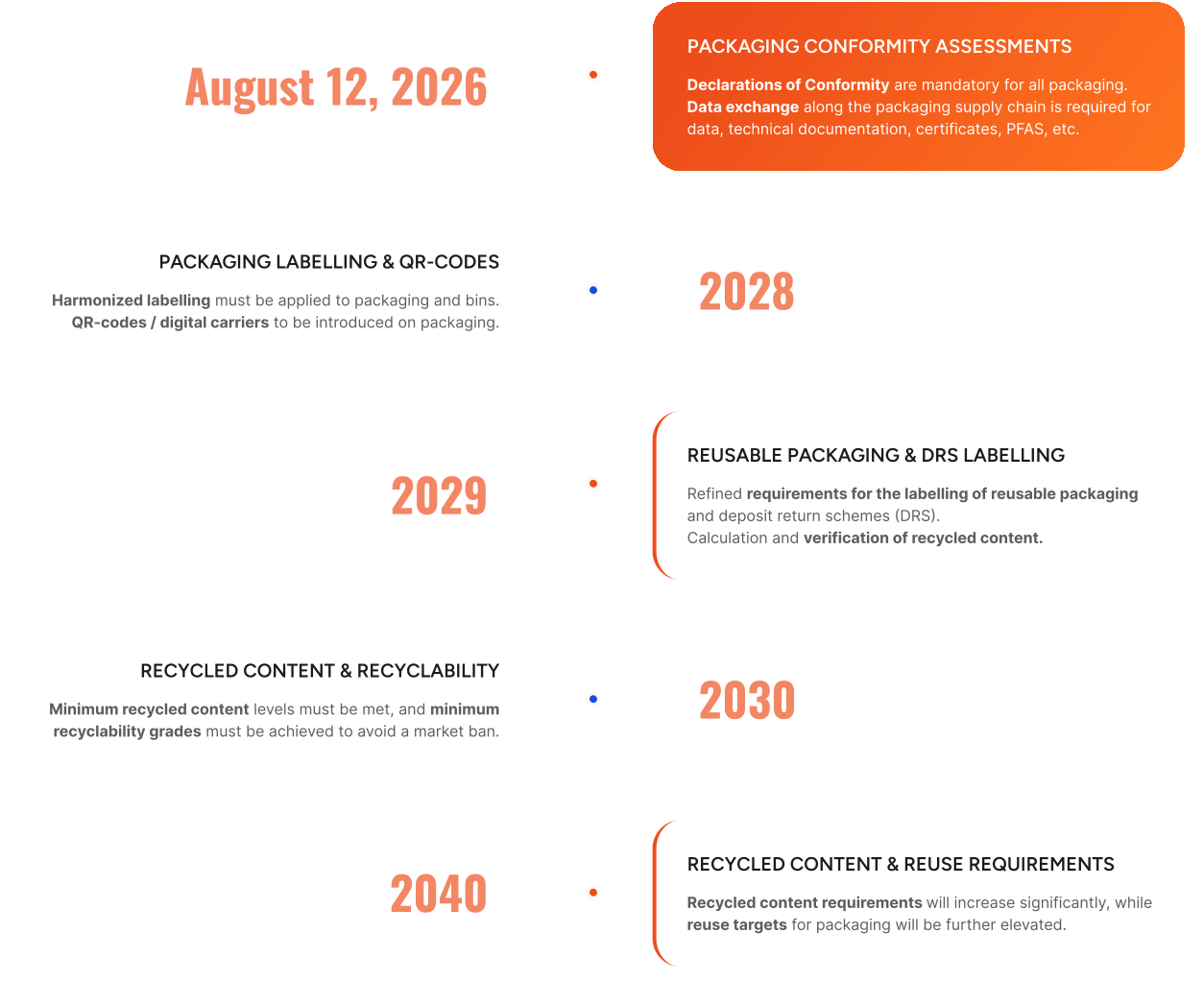
The PPWR Milestones at a Glance
Meet Deadlines. Avoid Market Bans. Avoid Fines.
The PPWR Milestones at a Glance
Meet Deadlines. Avoid Market Bans. Avoid Fines.
the PPWR Milestones at a Glance
August 12, 2026
PACKAGING CONFORMITY
ASSEsSMENTS
Declarations of Conformity are mandatory for all packaging. Data exchange along the packaging supply chain is required for data, technical documentation, certificates, PFAS, etc.
2028
Packaging Labelling & QR-CODES
Harmonized labelling must be applied to packaging and bins. QR-codes / digital carriers to be introduced on packaging.
2029
Reusable Packaging & DRS Labelling
Refined requirements for the labelling of reusable packaging and deposit return schemes (DRS). Calculation and verification of recycled content.
2030
Recycled Content & Recyclability
Minimum recycled content levels must be met, and minimum recyclability grades must be achieved to avoid a market ban.
2040
Recycled Content & Reuse Requirements
Recycled content requirements will increase significantly, while reuse targets for packaging will be further elevated.
Meet Deadlines. Avoid Market Bans. Avoid Fines.
Your PPWR Action Plan
Lay the Foundations
Before you touch any packaging data, three things need to be in place.
Name one PPWR owner.
Without a named person, everyone assumes someone else is handling it. This person becomes the internal expert on regulation, suppliers, and documentation.
Build your central system.
Decide where all packaging data, certificates, and Declarations of Conformity will live. It must be accessible to the PPWR owner and findable in five minutes by anyone else. A shared folder works. A dedicated packaging data management platform like PAQR works better.
Confirm your legal role.
Manufacturer, importer, or distributor? Your role isn’t fixed at the company level; it depends on each individual packaging type and transaction, determining which obligations apply.
Build Your Inventory
1️⃣ List every packaging type you place on the EU market.
2️⃣ Map every component per packaging unit. One packaging unit (water bottle) = Bottle + cap + shrink label.
3️⃣ Identify the supplier of each component.
4️⃣ Flag where data is missing or unknown.
Most businesses discover at this stage that they have more components than they thought, and fewer supplier records than they need. That is normal. The inventory gives you a clear picture of the gap.
Collect Missing Data
1️⃣ Contact each supplier with a structured data request. Ask specifically for: PFAS declarations, heavy metals certificates, and material specification sheets.
2️⃣ Follow up with suppliers weekly. Some respond quickly. Others need two to three weeks.
3️⃣ Verify incoming data against the requirements. Generic compliance statements are not enough. See the PFAS and heavy metals section below for what valid proof looks like.
4️⃣ Store all data centrally as it arrives.
Generate your DoC
1️⃣ Compile the technical documentation for each packaging type.
2️⃣ Perform the conformity assessment for each packaging unit.
3️⃣ Generate the Declaration of Conformity.
4️⃣ Review for completeness and accuracy before signing.
One DoC or many? PPWR technically permits one DoC to cover multiple variations of the same packaging type, provided the materials are identical. The same bottle in three sizes can share one DoC.
Best practice is a 1:1 relationship between DoC and packaging unit. If one variation changes, you update only that document rather than a shared one covering your full portfolio. It keeps changes contained and your records cleaner.
Label, Review and Finalise
1️⃣ Use dynamic QR codes to comply digitally with the labelling requirements set out in Article 15 as early as today.
2️⃣ Remove the PRO logos (e.g. the ‘Green Dot’) from your packaging and, if necessary, incorporate them digitally behind the QR code.
3️⃣ Cross-check every Declaration of Conformity against its supporting data.
4️⃣ Confirm your retention setup: 5 years for single-use packaging, 10 years for reusable. Importers must retain a copy of the DoC for the same timeframes.
5️⃣ Prepare for distribution. Your DoC must be shareable with auditors, retail buyers, or national authorities on request.
Make PPWR Part of Daily Operations
August 12 was the starting point, not the finish line.
Any significant change to a component, material, or supplier triggers a new conformity assessment. The process repeats: new material → new assessment → updated Declaration of Conformity → before the product ships.
For new products launched after August 12, the Declaration of Conformity must exist before the first unit leaves your facility or clears customs. For products sold online, it must be complete when the product is published.
The Documents You Need: PFAS and Heavy Metals
The PFAS restrictions apply specifically to food-contact packaging from August 12, 2026. If none of your packaging touches food, you can skip that part. The heavy metals limit applies to all packaging, regardless of what it contains.
PFAS: The Three Thresholds
Starting August 12, 2026, food-contact packaging cannot exceed:
✔️ 25 ppb for any single targeted PFAS
✔️ 250 ppb for the sum of targeted PFAS
✔️ 50 ppm for total PFAS, including polymeric PFAS
The practical tip: if your packaging material’s total fluorine content is below 50 mg/kg, you avoid the most demanding part of the documentation requirement. If it exceeds 50 mg/kg, you must obtain documentation specifically differentiating PFAS-sourced fluorine from non-PFAS fluorine, which is a significantly heavier ask. Confirming with your suppliers that they are below this threshold early is the fastest way to simplify your PFAS compliance.
What Valid PFAS Proof Looks Like
Green Flags for your PFAS Documentation
✅ Actual measured amounts (e.g., 8 ppb)
✅ Third-party lab report attached
✅ References the specific threshold (25 ppb / 250 ppb)
Red Flags for your PFAS Documentation
❌”No intentionally added PFAS”
❌”Free from PFAS”
❌”Compliant with PPWR,” without any measured PFAS amount or testing documentation
Practical tip: Watch out for the phrase “No intentionally added PFAS.” This doesn’t necessarily mean PFAS free. If the base material contained PFAS, this statement is meaningless.
Heavy Metals: What to Ask For
The combined concentration of lead, cadmium, mercury, and hexavalent chromium across all packaging materials cannot exceed 100 mg/kg. This includes inks, dyes, pigments, adhesives, primers, and coatings.
Always ask for actual measured test results, not a generic “compliant with PPWR” statement. The EU can lower this threshold in the future. Measured numbers remain valid if limits change, while a generic statement becomes useless the moment they do.
Ask for: Test results proving Pb + Cd + Hg + Cr(VI) combined does not exceed 100 mg/kg, or a declaration that names the specific threshold.
Do not accept: “Compliant with PPWR heavy metals requirements” with no measurement attached.
Material Composition: What You Need Per Component
For each packaging component, your technical documentation must include:
✔️ Component type (bottle, shrink wrap, label, box)
✔️ Material type (polymer, glass, metal, paper, cardboard)
✔️ Weight and dimensions
✔️ Plastic recycled content proof (mandatory by 2030)
✔️ Supplier specification documents
On layer-by-layer composition: component-level data is sufficient for the August 2026 deadline. Layer-level data will be required for 2030 recyclability grading. If your supplier can provide it now, collect it. If not, it can wait.
Your questions answered
These are the questions submitted
during the session, including any we
did not have time to address live.
Start with your food-contact packaging to confirm PFAS compliance, as these materials are under the highest regulatory and public scrutiny right now. However, remember that the strict heavy metal limits apply broadly to all your packaging, not just food-contact items.
Beyond chemical compliance, focus on your sales packaging first; the packaging that carries your name and brand. Because the legislation assigns the conformity obligation to the brand on the packaging, standard unbranded transport packaging remains your supplier’s responsibility, meaning it is not your immediate burden to declare for August 12. The core objective for August 12th is to have your Declaration of Conformity in place for your branded packaging, with the supporting data structured and retrievable.
The Declaration of Conformity is a living document. Any significant change to your packaging, whether a material reformulation, a new component, or a supplier change, triggers a new conformity assessment and an updated DoC. Importantly, you must retain the previous versions as well. Products placed on the market under an earlier version of the DoC remain linked to that version, which must stay on file and available for inspection. Retention requirements are five years for single-use packaging and ten years for reusable. As recyclability scoring requirements come into force in 2030, those changes will also need to flow into new assessments and updated declarations.
This is one of the most common challenges. Suppliers are often unable to provide the data immediately because they need to request it from their own suppliers further up the chain. Under Article 16 of PPWR, your packaging supplier has a legal obligation to provide you with all the information you need to conduct your conformity assessment. It is worth referring to that obligation directly in your data requests: this is not just a business request, it is a legal one. If a supplier remains unresponsive after reasonable follow-up, you have two practical options: commission the relevant testing yourself and recover the cost from the supplier later, or begin the process of replacing that supplier. Platforms like PAQR also give you a documented record of when data requests were sent and when, or whether, they were answered, which is useful if a dispute arises.
You are not required to share it proactively. Once issued, the Declaration of Conformity sits on your records. National authorities can request it within ten days, and you are legally obligated to provide it on that basis. Retailers may ask for proof of conformity, which can take various forms including a verification link or a digital reference rather than the full document. The practical position is this: issue your Declaration of Conformity, keep it accessible, and have it ready to share on request. You do not need to circulate it. You need to be able to produce it when asked.
Plenty of packaging already carries a QR code today, but it’s usually there for marketing purposes, occasionally linking to an ingredient list or another legal requirement. In principle that can be combined with Article 15, but what matters is whether the QR code itself actually meets the legal requirements: a unique identifier plus accessible manufacturer contact data. Most existing marketing QR codes don’t meet that bar. PAQR offers this built in, but a dedicated platform isn’t strictly required. A company could technically build a dynamic QR code themselves through their website or web agency, one that updates whenever the packaging changes. That said, this kind of traceability with a unique identifier is technically a fairly demanding build, so the recommendation is to use specialized software for it.
You’re free to create your own template. PAQR uses a template closely aligned with PPWR requirements and data minimization, including only the strictly necessary fields. As long as you meet the requirements of Annex VIII, you can brand and style the document however you like. The mandatory core content is: the manufacturer must be identifiable, the packaging must be identifiable and described (materials and components), it must state that the manufacturer is issuing the declaration under their sole responsibility, and it must show when, where, and by whom the DoC was issued. Everything else is open to branding and design choices.
Yes, absolutely. Following the conformity assessment, you can declare conformity, digitally sign the document within the platform, and generate a downloadable PDF that embeds your signature along with specific packaging details like custom descriptions and reference IDs. Currently, you can explicitly choose to instantly translate and download your signed DoC in 9 languages (English, German, Dutch, French, Spanish, Italian, Portuguese, Polish, Romanian).
A supplier’s compliance confirmation is better than nothing, since it’s at least a dated document, but concrete test results are clearly preferable. Article 16 obligates suppliers of packaging components and materials to hand over all information a producer needs to carry out a conformity assessment and issue a DoC. There’s some room to interpret exactly what’s required, but it’s fairly uncontested that the two thresholds covered in this session, heavy metals and PFAS for food-contact packaging, need to be verified. A generic pre-PPWR compliance statement won’t be enough on its own. The supplier needs to provide more concrete data, at minimum a confirmed limit, even short of exact measured results. Importantly, only the producer can determine from component-level data whether the overall packaging is compliant; the supplier can’t make that call for the full unit. The recommended move is to go back to the supplier and point to Article 16’s obligation to cooperate, since failing to meet it can also come back on the supplier.
This ties back to the distinction made earlier in the session between packaging conformity, which is EU-wide, and Extended Producer Responsibility (EPR), which is national and runs through national dual systems. Conformity is a single EU-wide matter. Once a Declaration of Conformity is issued, that single issuance is valid across the entire EU. With PAQR you can issue it in multiple EU languages if that’s useful for your markets, but fundamentally it only needs to be issued once. No separate DoC is required per country.
No statement regarding PFAS is required on the Declaration of Conformity itself. The Declaration of Conformity simply confirms that all applicable requirements are met; if PFAS limits were not met, no Declaration of Conformity could be issued in the first place. The real question is what proof you provide to reach this conclusion.
A common but insufficient approach is relying on an NIAS (non-intentionally added substances) declaration for PFAS. This is insufficient: the fact that a supplier did not intentionally add a substance says nothing about whether it was already present in a raw material or introduced unintentionally elsewhere in the supply chain. Its evidentiary value is low, and this is not considered a valid approach industry-wide.
The recommended fallback is to first determine total fluorine (TF) content, the lowest hurdle when requesting data from suppliers. If the TF limit is exceeded, you must either test the final packaging for specific target PFAS or obtain confirmation from all upstream supply chain parties that neither intentional nor unintentional addition occurred. The second option is a major undertaking that few suppliers are willing to commit to. In practice, producers will either need to obtain specific, quantified data from upstream suppliers or commission the testing themselves.
Assuming the finished goods bear your brand, you are the manufacturer placing the product on the market. Therefore, you are responsible for verifying and confirming conformity, not the co-packer.
The external partner acts as a co-packer using their own packaging supplier. You are entitled to require your co-packer to provide data on the packaging used (in this case, the standard carton) so you can conduct the assessment yourself.
Nuance: This might look different if the standard carton serves as transport packaging rather than sales packaging, that should be clarified in a separate step. As a general rule, however, if a co-packer uses sales packaging bearing your brand, responsibility rests with you.
If multiple sales units are combined within grouped packaging (the classic example being a six-pack of water bottles), the individual units inside also require their own label. These inner units are the sales units that typically become waste once the consumer uses or consumes the product.
Each inner unit requires a label that remains visible even after the grouped packaging is opened and discarded, allowing consumers to identify the producer and, starting in 2028, see the recycling logo.
As a rule, labels must be visible, legible, and permanently affixed, printed, or engraved directly on the packaging. However, if this is not possible or reasonable due to the nature and size of the packaging, the label, QR code, or digital data carrier may instead be affixed to the grouped packaging (outer packaging).
Under the Packaging Regulation (PPWR), you do not need to create a completely new conformity document from scratch; however, you are legally obligated to update your existing technical documentation and the EU Declaration of Conformity.
Manufacturers must reassess conformity whenever packaging characteristics change, as even a seemingly minor change like a new adhesive is considered a critical conformity component. For example, the regulation’s design-for-recycling criteria specifically evaluate whether adhesives are washable and separate cleanly without leaving residues that could contaminate secondary raw materials. In addition, you must verify that the new adhesive continues to comply with strict concentration limits for heavy metals, specifically lead, cadmium, mercury, and hexavalent chromium, as well as other substances of concern.
To manage this update, lean on your new supplier, who is legally obligated to provide all necessary technical information demonstrating material conformity. Request the relevant information from them, incorporate these new specifications into your technical documentation, and verify that the box continues to pass the conformity assessment. Once confirmed, simply update the version history of your existing Declaration of Conformity to reflect the new adhesive.
Under the Packaging Regulation (PPWR), you must evaluate pallets and cartons separately rather than treating the entire shipment as a single, mixed packaging unit.
The regulation defines a “packaging unit” as encompassing items that together fulfill a packaging function, but explicitly notes that this includes independent units of transport packaging. Furthermore, it distinguishes between “integrated” and “separate” components. Because cartons and pallets are distinct items that are permanently separable and typically disposed of through different waste streams or at different times, they qualify as separate components or completely independent packaging units.
Under Regulation (EU) 2025/40 (PPWR), a non-EU manufacturer can certainly have multiple importers across the European Union, including several distinct importers within the same Member State. The regulation defines an importer as any natural or legal person established in the Union that places packaging from a third country on the Union market. Because importer status is determined by the physical introduction and first making available of specific third-country packaging on the market rather than an exclusive legal mandate, a non-EU producer is free to supply multiple EU-based distributors or buyers who each act as the importer of record for their respective shipments. Crucially, each importer is responsible strictly and exclusively for the specific packaging units that it places on the Union market. Under Article 18 of the PPWR, an importer’s obligations, such as verifying that the non-EU manufacturer completed the required conformity assessment, ensuring proper labelling, maintaining the EU Declaration of Conformity and technical documentation for market surveillance, and fulfilling Extended Producer Responsibility (EPR) registration, apply only to its own imported stock. One importer holds no legal liability or financial EPR responsibility for packaging imported independently by another company.
Under Article 16(1) of the PPWR, suppliers are legally obligated to provide manufacturers with all the information and documentation necessary to demonstrate that the packaging complies with the regulation. A supplier’s written declaration of compliance or material specification sheet can be sufficient if it contains verifiable composition data and a sound risk assessment that you can include in your technical file. However, a generic statement (e.g., simply stating “this box complies with heavy metal limits”) without underlying technical or chemical data may not satisfy Annex VII requirements if audited by market surveillance authorities. As the manufacturer placing the product on the market, the legal responsibility for drawing up the EU Declaration of Conformity ultimately rests with you. If you feel a supplier declaration lacks sufficient detail to prove compliance, you can require them to share test reports or underlying analytical data under Article 16(1).
Under the Packaging and Packaging Waste Regulation (PPWR), chemical manufacturers are impacted primarily as upstream suppliers of raw materials, such as polymers, resins, inks, and coatings, and as economic operators packaging their own products.
As upstream suppliers, Article 16 legally obligates them to provide downstream packaging manufacturers with all technical documentation and material composition data necessary to demonstrate compliance. This includes verifying that supplied materials meet heavy metal concentration limits (a combined maximum of 100 mg/kg for lead, cadmium, mercury, and hexavalent chromium), declare fluorine or PFAS content where applicable, and disclose substances of concern that could affect circularity or chemical safety.
When chemical companies package and ship their own products, besides their role as manufacturer, they act as economic operators subject to Extended Producer Responsibility (EPR) registration, and re-use targets for industrial transport packaging. Notably, plastic packaging specifically used for the transport of dangerous goods under Directive 2008/68/EC is granted a specific exemption from mandatory post-consumer recycled content targets. Additionally, chemical companies developing recycling technologies must ensure their output materials meet EU sustainability, chain-of-custody, and food-contact safety standards.
Yes, PAQR can integrate with ERP systems, including SAP, Oracle or Microsoft Dynamics. Apart from that, integration with Product Information Management systems or eCommerce-Suites is available as well.
Yes, in the August update of the EU Commission’s PPWR FAQ, there was a major shift regarding the manufacturer role for transport packaging. Previously, the guidelines distinguished between rigid packaging (e.g., pallets, boxes) and flexible packaging (e.g., tape, shrink wrap). That distinction has been simplified: you now only need to check if the packaging is branded or custom-designed for a specific company other than the physical maker. If it is not, the physical manufacturer is considered the “manufacturer” under PPWR. As a result, primary responsibility for flexible transport packaging has shifted back toward the physical manufacturer.
In theory, yes. Article 16 establishes a universal duty for suppliers to provide all data required for your Declaration of Conformity (DoC) to ensure a level playing field across the EU. However, because non-EU suppliers operate outside EU legal jurisdiction, direct legal enforcement isn’t feasible. In practice, enforcement comes down to commercial leverage, meaning you would need to leverage civil contracts or stop purchasing from them if they refuse to supply the required data.
No, you do not need to transfer all the detailed technical data provided by your suppliers directly onto your official EU Declaration of Conformity (DoC). The DoC is intended to be a high-level, streamlined statement that follows a strict, simplified model structure outlined in Annex VIII. It primarily contains essential administrative details, including the manufacturer’s identity, a clear description of the packaging to allow for traceability, a statement declaring sole responsibility for compliance, and references to any harmonized standards or common specifications used to demonstrate conformity.
Instead, the granular composition data, test reports, and material specifications you receive from your suppliers belong in your internal Technical Documentation file (under Annex VII). This technical file acts as the comprehensive repository for all underlying evidence, such as qualitative descriptions of recyclability, packaging minimisation design calculations, and supplier declarations, proving compliance with the PPWR. While you are legally required to draw up the DoC and keep it together with this technical file for 5 years for single-use packaging and 10 years for reusable packaging (measured from the date the packaging was placed on the market), the extensive technical dossier is kept on hand for market surveillance authorities and only needs to be provided upon their request.
Under the EU Packaging and Packaging Waste Regulation (PPWR), the obligation to register for Extended Producer Responsibility (EPR) in a member state depends strictly on the sales channel, and on who makes packaged products available in the territory for the first time.
For your German home market, you are considered the producer making packaged products available for the first time. This means you must register with the national register in Germany (LUCID). For B2B sales to local distributors in other member states, those distributors are legally considered the producers because they are making your packaged goods available in that territory for the first time. This frees you from registration obligations there.
However, for direct B2C distance sales via your webshop to consumers in other member states, you are considered the producer and must register in each destination country. Since you have no establishment in these B2C destination countries, you should review your registration, reporting, and fee obligations for EPR in each country. In many countries, you are also required to appoint a locally based authorized representative to fulfill these obligations on your behalf.
There is an important distinction between the substantive sustainability requirements (Articles 5 to 12) and administrative or labelling obligations (such as Articles 12 and 15.) An “exhaustion of stock” exception is only granted for the latter, never for the sustainability requirements. That means that all packaging placed on the market after 12 August 2026 has to undergo a conformity assessment, supported by technical documentation and evidenced by a declaration of conformity. For non-food packaging this assessment would typically comprise checks of heavy metals. To satisfy the mandatory Article 15 traceability and contact requirements, when eventually placing this stock on the market, you can provide the necessary details in accompanying commercial documentation, such as invoices or shipping papers and do not need to remanufacture or physically relabel packaging. Furthermore, market surveillance authorities are instructed to use a supportive enforcement approach, issuing formal warnings to allow for corrective documentation before taking any trade-disrupting actions.
The core sustainability, labeling, and Extended Producer Responsibility (EPR) requirements of the PPWR do not apply to packaging or products exported directly to countries outside the EU market. However, if packaging materials are initially purchased or distributed within the EU prior to export, those upstream transactions must still meet fundamental EU chemical and safety standards, such as heavy metal and PFAS limits.
Operationally, you can use basic Extended Producer Responsibility (EPR) data, such as high-level material classifications and component weights, to draft an EU Declaration of Conformity (DoC) shell and establish your initial technical file. However, EPR data alone is legally insufficient to finalize or sign the document, as executing a DoC legally certifies full compliance with stricter PPWR requirements like substance safety limits, packaging minimization, and design-for-recycling assessments. To legally sign off on the DoC, you must supplement your basic EPR structure with supplier test reports and technical evidence collected under Article 16 to complete your full Annex VII dossier.
Yes, under Annex VII of the PPWR, conceptual design and manufacturing drawings are explicitly mandatory components of the technical documentation. These schematics, along with component specifications and explanatory notes, provide market surveillance authorities with the necessary visibility into the packaging’s physical design, dimensions, and material composition. While complex or custom multi-component packaging requires formal technical or CAD drawings, simpler off-the-shelf packaging can satisfy the regulation’s “wherever applicable” clause using basic visual component breakdowns or dimensional diagrams.
The PPWR strictly limits which symbols may appear on packaging. Extended producer responsibility markings such as the Green Dot must be removed by February 12, 2027, because consumers often mistake them for an indicator of recyclability. The EU is also introducing a harmonized sorting label, expected around 2028 or 2029, which will match the symbols on waste bins across Europe so consumers can easily identify the right bin. Packaging may additionally display its recyclability performance grade and its share of recycled content. More detailed guidance, such as how to separate individual packaging components, belongs behind a QR code rather than printed on the packaging itself. Under the EmpCo rules, environmental claims are not banned outright, but vague, generic, or misleading statements are prohibited. You may only make a sustainability claim if you can support it with clear, robust documentation.
The ultimate goal is full Declaration of Conformity (DoC) coverage across your entire portfolio, with a DoC in place for every packaging type you place on the EU market. If limited resources require a phased rollout, one way to prioritize is a risk-and-impact approach. Start with food-contact materials, which face stricter regulatory scrutiny than non-food applications. For these, collect PFAS documentation first, checking total fluorine as your initial screen. Heavy metals declarations apply to all packaging, so gather those alongside. Next, focus on high-volume, high-turnover lines, such as your top-selling products and frequently shipped batches, where a documentation gap could disrupt your supply chain the most. Then address consumer-facing sales packaging before moving to transport or grouped packaging. Finally, target high-risk components, meaning categories where specific components or suppliers could become a compliance bottleneck, and verify Article 15 compliance for all packagings. Treat this as one way to sequence the work, not a reason to leave any SKU undocumented, since the end goal is a DoC for every packaging type in your portfolio.
A new conformity assessment and Declaration of Conformity (DoC) are only required when a change directly affects the packaging’s regulatory conformity. Changing the glue formulation or material type would likely affect conformity and therefore require a new assessment and DoC. Switching suppliers for the exact same glue specification and brand does not trigger a new DoC, but the technical documentation must be updated, because the Packaging and Packaging Waste Regulation (PPWR) requires full traceability of all packaging components and suppliers. Likewise, minor artwork changes, such as updating language or text, do not affect conformity as long as the inks, substrates, and printing processes stay the same. In that case, only the technical documentation needs to be updated.
The PAQR platform is built specifically for this purpose. Because the PPWR relies on roughly 27 to 29 subsequent delegated and implementing acts over the coming years, rules and technical specifications will roll out in stages rather than all at once. The platform continuously updates as these secondary legal acts are adopted, alerts teams to upcoming deadlines, highlights missing data points across your packaging portfolio, and guides businesses through step-by-step compliance requirements.
You are responsible. Under the PPWR, any company that has packaging designed or manufactured and placed on the market under its own name or trademark is legally defined as the manufacturer. This means you must establish the technical documentation and issue and sign the EU Declaration of Conformity.
Yes, the requirements under Article 15(5) and 15(6) apply to all packaging, including transport packaging such as pallets, shipping boxes, and stretch film. However, the legal responsibility to provide contact details and a batch or serial number falls on the packaging manufacturer who places the empty packaging item on the market, not necessarily on the company using it to ship products.
If you purchase standard, unbranded transport packaging, such as generic stretch film or standard wooden pallets, the original producer of that packaging is responsible for applying their details. For items where direct marking on the surface is not feasible, such as thin film, Article 15 allows the required identification and contact information to be provided in accompanying commercial documentation. You only assume manufacturer obligations if you have the transport packaging designed or produced under your own brand name or trademark, or if you modify it in a way that affects legal compliance.
You do not need to create a completely new numbering system. Article 15(5) requires packaging to bear a type, batch, serial number, or other element allowing its identification. An existing EAN, GTIN, SKU, or catalogue number satisfies this requirement as long as it allows authorities to trace the packaging and clearly links that specific packaging format to its technical documentation and EU Declaration of Conformity.
The key condition is maintaining unambiguous traceability. If your product’s packaging design or material specification changes while the product continues to use the same retail barcode, you must ensure that a batch, lot, or version identifier is included so authorities can distinguish between the different packaging versions.
No, Article 15 does not require marking each separate component. The obligations apply to the packaging unit as a whole, which encompasses its integrated elements. If your packaging unit consists of a cardboard box sealed with adhesive tape and a label, the manufacturer contact details and batch or identification number only need to appear once on that packaging unit. Under Article 15, this includes the unique identification (“number”) as well as the company name, trademark, and contact details of the manufacturer and, where applicable, the importer.
Yes. When you produce service packaging that carries your own company name, trademark, or logo, you are the legal manufacturer placing empty packaging on the EU market. You must compile the technical documentation and draw up the EU Declaration of Conformity before supplying the packaging to your customers.
If your customer asks you to apply their own brand, name, or logo to the packaging, they assume the legal role of the manufacturer and become responsible for issuing the Declaration of Conformity, while you supply the supporting technical data under Article 16.
Frequently
Asked Questions
Start with your food-contact packaging to confirm PFAS compliance, as these materials are under the highest regulatory and public scrutiny right now. However, remember that the strict heavy metal limits apply broadly to all your packaging, not just food-contact items.
Beyond chemical compliance, focus on your sales packaging first; the packaging that carries your name and brand. Because the legislation assigns the conformity obligation to the brand on the packaging, standard unbranded transport packaging remains your supplier’s responsibility, meaning it is not your immediate burden to declare for August 12. The core objective for August 12th is to have your Declaration of Conformity in place for your branded packaging, with the supporting data structured and retrievable.
The Declaration of Conformity is a living document. Any significant change to your packaging, whether a material reformulation, a new component, or a supplier change, triggers a new conformity assessment and an updated DoC. Importantly, you must retain the previous versions as well. Products placed on the market under an earlier version of the DoC remain linked to that version, which must stay on file and available for inspection. Retention requirements are five years for single-use packaging and ten years for reusable. As recyclability scoring requirements come into force in 2030, those changes will also need to flow into new assessments and updated declarations.
This is one of the most common challenges. Suppliers are often unable to provide the data immediately because they need to request it from their own suppliers further up the chain. Under Article 16 of PPWR, your packaging supplier has a legal obligation to provide you with all the information you need to conduct your conformity assessment. It is worth referring to that obligation directly in your data requests: this is not just a business request, it is a legal one. If a supplier remains unresponsive after reasonable follow-up, you have two practical options: commission the relevant testing yourself and recover the cost from the supplier later, or begin the process of replacing that supplier. Platforms like PAQR also give you a documented record of when data requests were sent and when, or whether, they were answered, which is useful if a dispute arises.
You are not required to share it proactively. Once issued, the Declaration of Conformity sits on your records. National authorities can request it within ten days, and you are legally obligated to provide it on that basis. Retailers may ask for proof of conformity, which can take various forms including a verification link or a digital reference rather than the full document. The practical position is this: issue your Declaration of Conformity, keep it accessible, and have it ready to share on request. You do not need to circulate it. You need to be able to produce it when asked.
Plenty of packaging already carries a QR code today, but it’s usually there for marketing purposes, occasionally linking to an ingredient list or another legal requirement. In principle that can be combined with Article 15, but what matters is whether the QR code itself actually meets the legal requirements: a unique identifier plus accessible manufacturer contact data. Most existing marketing QR codes don’t meet that bar. PAQR offers this built in, but a dedicated platform isn’t strictly required. A company could technically build a dynamic QR code themselves through their website or web agency, one that updates whenever the packaging changes. That said, this kind of traceability with a unique identifier is technically a fairly demanding build, so the recommendation is to use specialized software for it.
You’re free to create your own template. PAQR uses a template closely aligned with PPWR requirements and data minimization, including only the strictly necessary fields. As long as you meet the requirements of Annex VIII, you can brand and style the document however you like. The mandatory core content is: the manufacturer must be identifiable, the packaging must be identifiable and described (materials and components), it must state that the manufacturer is issuing the declaration under their sole responsibility, and it must show when, where, and by whom the DoC was issued. Everything else is open to branding and design choices.
Yes, absolutely. Following the conformity assessment, you can declare conformity, digitally sign the document within the platform, and generate a downloadable PDF that embeds your signature along with specific packaging details like custom descriptions and reference IDs. Currently, you can explicitly choose to instantly translate and download your signed DoC in 9 languages (English, German, Dutch, French, Spanish, Italian, Portuguese, Polish, Romanian).
A supplier’s compliance confirmation is better than nothing, since it’s at least a dated document, but concrete test results are clearly preferable. Article 16 obligates suppliers of packaging components and materials to hand over all information a producer needs to carry out a conformity assessment and issue a DoC. There’s some room to interpret exactly what’s required, but it’s fairly uncontested that the two thresholds covered in this session, heavy metals and PFAS for food-contact packaging, need to be verified. A generic pre-PPWR compliance statement won’t be enough on its own. The supplier needs to provide more concrete data, at minimum a confirmed limit, even short of exact measured results. Importantly, only the producer can determine from component-level data whether the overall packaging is compliant; the supplier can’t make that call for the full unit. The recommended move is to go back to the supplier and point to Article 16’s obligation to cooperate, since failing to meet it can also come back on the supplier.
This ties back to the distinction made earlier in the session between packaging conformity, which is EU-wide, and Extended Producer Responsibility (EPR), which is national and runs through national dual systems. Conformity is a single EU-wide matter. Once a Declaration of Conformity is issued, that single issuance is valid across the entire EU. With PAQR you can issue it in multiple EU languages if that’s useful for your markets, but fundamentally it only needs to be issued once. No separate DoC is required per country.
No statement regarding PFAS is required on the Declaration of Conformity itself. The Declaration of Conformity simply confirms that all applicable requirements are met; if PFAS limits were not met, no Declaration of Conformity could be issued in the first place. The real question is what proof you provide to reach this conclusion.
A common but insufficient approach is relying on an NIAS (non-intentionally added substances) declaration for PFAS. This is insufficient: the fact that a supplier did not intentionally add a substance says nothing about whether it was already present in a raw material or introduced unintentionally elsewhere in the supply chain. Its evidentiary value is low, and this is not considered a valid approach industry-wide.
The recommended fallback is to first determine total fluorine (TF) content, the lowest hurdle when requesting data from suppliers. If the TF limit is exceeded, you must either test the final packaging for specific target PFAS or obtain confirmation from all upstream supply chain parties that neither intentional nor unintentional addition occurred. The second option is a major undertaking that few suppliers are willing to commit to. In practice, producers will either need to obtain specific, quantified data from upstream suppliers or commission the testing themselves.
Assuming the finished goods bear your brand, you are the manufacturer placing the product on the market. Therefore, you are responsible for verifying and confirming conformity, not the co-packer.
The external partner acts as a co-packer using their own packaging supplier. You are entitled to require your co-packer to provide data on the packaging used (in this case, the standard carton) so you can conduct the assessment yourself.
Nuance: This might look different if the standard carton serves as transport packaging rather than sales packaging, that should be clarified in a separate step. As a general rule, however, if a co-packer uses sales packaging bearing your brand, responsibility rests with you.
If multiple sales units are combined within grouped packaging (the classic example being a six-pack of water bottles), the individual units inside also require their own label. These inner units are the sales units that typically become waste once the consumer uses or consumes the product.
Each inner unit requires a label that remains visible even after the grouped packaging is opened and discarded, allowing consumers to identify the producer and, starting in 2028, see the recycling logo.
As a rule, labels must be visible, legible, and permanently affixed, printed, or engraved directly on the packaging. However, if this is not possible or reasonable due to the nature and size of the packaging, the label, QR code, or digital data carrier may instead be affixed to the grouped packaging (outer packaging).
Under the Packaging Regulation (PPWR), you do not need to create a completely new conformity document from scratch; however, you are legally obligated to update your existing technical documentation and the EU Declaration of Conformity.
Manufacturers must reassess conformity whenever packaging characteristics change, as even a seemingly minor change like a new adhesive is considered a critical conformity component. For example, the regulation’s design-for-recycling criteria specifically evaluate whether adhesives are washable and separate cleanly without leaving residues that could contaminate secondary raw materials. In addition, you must verify that the new adhesive continues to comply with strict concentration limits for heavy metals, specifically lead, cadmium, mercury, and hexavalent chromium, as well as other substances of concern.
To manage this update, lean on your new supplier, who is legally obligated to provide all necessary technical information demonstrating material conformity. Request the relevant information from them, incorporate these new specifications into your technical documentation, and verify that the box continues to pass the conformity assessment. Once confirmed, simply update the version history of your existing Declaration of Conformity to reflect the new adhesive.
Under the Packaging Regulation (PPWR), you must evaluate pallets and cartons separately rather than treating the entire shipment as a single, mixed packaging unit.
The regulation defines a “packaging unit” as encompassing items that together fulfill a packaging function, but explicitly notes that this includes independent units of transport packaging. Furthermore, it distinguishes between “integrated” and “separate” components. Because cartons and pallets are distinct items that are permanently separable and typically disposed of through different waste streams or at different times, they qualify as separate components or completely independent packaging units.
Under Regulation (EU) 2025/40 (PPWR), a non-EU manufacturer can certainly have multiple importers across the European Union, including several distinct importers within the same Member State. The regulation defines an importer as any natural or legal person established in the Union that places packaging from a third country on the Union market. Because importer status is determined by the physical introduction and first making available of specific third-country packaging on the market rather than an exclusive legal mandate, a non-EU producer is free to supply multiple EU-based distributors or buyers who each act as the importer of record for their respective shipments. Crucially, each importer is responsible strictly and exclusively for the specific packaging units that it places on the Union market. Under Article 18 of the PPWR, an importer’s obligations, such as verifying that the non-EU manufacturer completed the required conformity assessment, ensuring proper labelling, maintaining the EU Declaration of Conformity and technical documentation for market surveillance, and fulfilling Extended Producer Responsibility (EPR) registration, apply only to its own imported stock. One importer holds no legal liability or financial EPR responsibility for packaging imported independently by another company.
Under Article 16(1) of the PPWR, suppliers are legally obligated to provide manufacturers with all the information and documentation necessary to demonstrate that the packaging complies with the regulation. A supplier’s written declaration of compliance or material specification sheet can be sufficient if it contains verifiable composition data and a sound risk assessment that you can include in your technical file. However, a generic statement (e.g., simply stating “this box complies with heavy metal limits”) without underlying technical or chemical data may not satisfy Annex VII requirements if audited by market surveillance authorities. As the manufacturer placing the product on the market, the legal responsibility for drawing up the EU Declaration of Conformity ultimately rests with you. If you feel a supplier declaration lacks sufficient detail to prove compliance, you can require them to share test reports or underlying analytical data under Article 16(1).
Under the Packaging and Packaging Waste Regulation (PPWR), chemical manufacturers are impacted primarily as upstream suppliers of raw materials, such as polymers, resins, inks, and coatings, and as economic operators packaging their own products.
As upstream suppliers, Article 16 legally obligates them to provide downstream packaging manufacturers with all technical documentation and material composition data necessary to demonstrate compliance. This includes verifying that supplied materials meet heavy metal concentration limits (a combined maximum of 100 mg/kg for lead, cadmium, mercury, and hexavalent chromium), declare fluorine or PFAS content where applicable, and disclose substances of concern that could affect circularity or chemical safety.
When chemical companies package and ship their own products, besides their role as manufacturer, they act as economic operators subject to Extended Producer Responsibility (EPR) registration, and re-use targets for industrial transport packaging. Notably, plastic packaging specifically used for the transport of dangerous goods under Directive 2008/68/EC is granted a specific exemption from mandatory post-consumer recycled content targets. Additionally, chemical companies developing recycling technologies must ensure their output materials meet EU sustainability, chain-of-custody, and food-contact safety standards.
Yes, PAQR can integrate with ERP systems, including SAP, Oracle or Microsoft Dynamics. Apart from that, integration with Product Information Management systems or eCommerce-Suites is available as well.
Yes, in the August update of the EU Commission’s PPWR FAQ, there was a major shift regarding the manufacturer role for transport packaging. Previously, the guidelines distinguished between rigid packaging (e.g., pallets, boxes) and flexible packaging (e.g., tape, shrink wrap). That distinction has been simplified: you now only need to check if the packaging is branded or custom-designed for a specific company other than the physical maker. If it is not, the physical manufacturer is considered the “manufacturer” under PPWR. As a result, primary responsibility for flexible transport packaging has shifted back toward the physical manufacturer.
In theory, yes. Article 16 establishes a universal duty for suppliers to provide all data required for your Declaration of Conformity (DoC) to ensure a level playing field across the EU. However, because non-EU suppliers operate outside EU legal jurisdiction, direct legal enforcement isn’t feasible. In practice, enforcement comes down to commercial leverage, meaning you would need to leverage civil contracts or stop purchasing from them if they refuse to supply the required data.
No, you do not need to transfer all the detailed technical data provided by your suppliers directly onto your official EU Declaration of Conformity (DoC). The DoC is intended to be a high-level, streamlined statement that follows a strict, simplified model structure outlined in Annex VIII. It primarily contains essential administrative details, including the manufacturer’s identity, a clear description of the packaging to allow for traceability, a statement declaring sole responsibility for compliance, and references to any harmonised standards or common specifications used to demonstrate conformity.
Instead, the granular composition data, test reports, and material specifications you receive from your suppliers belong in your internal Technical Documentation file (under Annex VII). This technical file acts as the comprehensive repository for all underlying evidence, such as qualitative descriptions of recyclability, packaging minimisation design calculations, and supplier declarations, proving compliance with the PPWR. While you are legally required to draw up the DoC and keep it together with this technical file for 5 years for single-use packaging and 10 years for reusable packaging (measured from the date the packaging was placed on the market), the extensive technical dossier is kept on hand for market surveillance authorities and only needs to be provided upon their request.
Under the EU Packaging and Packaging Waste Regulation (PPWR), the obligation to register for Extended Producer Responsibility (EPR) in a member state depends strictly on the sales channel, and on who makes packaged products available in the territory for the first time.
For your German home market, you are considered the producer making packaged products available for the first time. This means you must register with the national register in Germany (LUCID). For B2B sales to local distributors in other member states, those distributors are legally considered the producers because they are making your packaged goods available in that territory for the first time. This frees you from registration obligations there.
However, for direct B2C distance sales via your webshop to consumers in other member states, you are considered the producer and must register in each destination country. Since you have no establishment in these B2C destination countries, you should review your registration, reporting, and fee obligations for EPR in each country. In many countries, you are also required to appoint a locally based authorized representative to fulfill these obligations on your behalf.
There is an important distinction between the substantive sustainability requirements (Articles 5 to 12) and administrative or labelling obligations (such as Articles 12 and 15.) An “exhaustion of stock” exception is only granted for the latter, never for the sustainability requirements. That means that all packaging placed on the market after 12 August 2026 has to undergo a conformity assessment, supported by technical documentation and evidenced by a declaration of conformity. For non-food packaging this assessment would typically comprise checks of heavy metals. To satisfy the mandatory Article 15 traceability and contact requirements, when eventually placing this stock on the market, you can provide the necessary details in accompanying commercial documentation, such as invoices or shipping papers and do not need to remanufacture or physically relabel packaging. Furthermore, market surveillance authorities are instructed to use a supportive enforcement approach, issuing formal warnings to allow for corrective documentation before taking any trade-disrupting actions.
The core sustainability, labeling, and Extended Producer Responsibility (EPR) requirements of the PPWR do not apply to packaging or products exported directly to countries outside the EU market. However, if packaging materials are initially purchased or distributed within the EU prior to export, those upstream transactions must still meet fundamental EU chemical and safety standards, such as heavy metal and PFAS limits.
Operationally, you can use basic Extended Producer Responsibility (EPR) data, such as high-level material classifications and component weights, to draft an EU Declaration of Conformity (DoC) shell and establish your initial technical file. However, EPR data alone is legally insufficient to finalize or sign the document, as executing a DoC legally certifies full compliance with stricter PPWR requirements like substance safety limits, packaging minimization, and design-for-recycling assessments. To legally sign off on the DoC, you must supplement your basic EPR structure with supplier test reports and technical evidence collected under Article 16 to complete your full Annex VII dossier.
Yes, under Annex VII of the PPWR, conceptual design and manufacturing drawings are explicitly mandatory components of the technical documentation. These schematics, along with component specifications and explanatory notes, provide market surveillance authorities with the necessary visibility into the packaging’s physical design, dimensions, and material composition. While complex or custom multi-component packaging requires formal technical or CAD drawings, simpler off-the-shelf packaging can satisfy the regulation’s “wherever applicable” clause using basic visual component breakdowns or dimensional diagrams.
The PPWR strictly limits which symbols may appear on packaging. Extended producer responsibility markings such as the Green Dot must be removed by February 12, 2027, because consumers often mistake them for an indicator of recyclability. The EU is also introducing a harmonized sorting label, expected around 2028 or 2029, which will match the symbols on waste bins across Europe so consumers can easily identify the right bin. Packaging may additionally display its recyclability performance grade and its share of recycled content. More detailed guidance, such as how to separate individual packaging components, belongs behind a QR code rather than printed on the packaging itself. Under the EmpCo rules, environmental claims are not banned outright, but vague, generic, or misleading statements are prohibited. You may only make a sustainability claim if you can support it with clear, robust documentation.
The ultimate goal is full Declaration of Conformity (DoC) coverage across your entire portfolio, with a DoC in place for every packaging type you place on the EU market. If limited resources require a phased rollout, one way to prioritize is a risk-and-impact approach. Start with food-contact materials, which face stricter regulatory scrutiny than non-food applications. For these, collect PFAS documentation first, checking total fluorine as your initial screen. Heavy metals declarations apply to all packaging, so gather those alongside. Next, focus on high-volume, high-turnover lines, such as your top-selling products and frequently shipped batches, where a documentation gap could disrupt your supply chain the most. Then address consumer-facing sales packaging before moving to transport or grouped packaging. Finally, target high-risk components, meaning categories where specific components or suppliers could become a compliance bottleneck, and verify Article 15 compliance for all packagings. Treat this as one way to sequence the work, not a reason to leave any SKU undocumented, since the end goal is a DoC for every packaging type in your portfolio.
A new conformity assessment and Declaration of Conformity (DoC) are only required when a change directly affects the packaging’s regulatory conformity. Changing the glue formulation or material type would likely affect conformity and therefore require a new assessment and DoC. Switching suppliers for the exact same glue specification and brand does not trigger a new DoC, but the technical documentation must be updated, because the Packaging and Packaging Waste Regulation (PPWR) requires full traceability of all packaging components and suppliers. Likewise, minor artwork changes, such as updating language or text, do not affect conformity as long as the inks, substrates, and printing processes stay the same. In that case, only the technical documentation needs to be updated.
The PAQR platform is built specifically for this purpose. Because the PPWR relies on roughly 27 to 29 subsequent delegated and implementing acts over the coming years, rules and technical specifications will roll out in stages rather than all at once. The platform continuously updates as these secondary legal acts are adopted, alerts teams to upcoming deadlines, highlights missing data points across your packaging portfolio, and guides businesses through step-by-step compliance requirements.
You are responsible. Under the PPWR, any company that has packaging designed or manufactured and placed on the market under its own name or trademark is legally defined as the manufacturer. This means you must establish the technical documentation and issue and sign the EU Declaration of Conformity.
Yes, the requirements under Article 15(5) and 15(6) apply to all packaging, including transport packaging such as pallets, shipping boxes, and stretch film. However, the legal responsibility to provide contact details and a batch or serial number falls on the packaging manufacturer who places the empty packaging item on the market, not necessarily on the company using it to ship products.
If you purchase standard, unbranded transport packaging, such as generic stretch film or standard wooden pallets, the original producer of that packaging is responsible for applying their details. For items where direct marking on the surface is not feasible, such as thin film, Article 15 allows the required identification and contact information to be provided in accompanying commercial documentation. You only assume manufacturer obligations if you have the transport packaging designed or produced under your own brand name or trademark, or if you modify it in a way that affects legal compliance.
You do not need to create a completely new numbering system. Article 15(5) requires packaging to bear a type, batch, serial number, or other element allowing its identification. An existing EAN, GTIN, SKU, or catalogue number satisfies this requirement as long as it allows authorities to trace the packaging and clearly links that specific packaging format to its technical documentation and EU Declaration of Conformity.
The key condition is maintaining unambiguous traceability. If your product’s packaging design or material specification changes while the product continues to use the same retail barcode, you must ensure that a batch, lot, or version identifier is included so authorities can distinguish between the different packaging versions.
No, Article 15 does not require marking each separate component. The obligations apply to the packaging unit as a whole, which encompasses its integrated elements. If your packaging unit consists of a cardboard box sealed with adhesive tape and a label, the manufacturer contact details and batch or identification number only need to appear once on that packaging unit. Under Article 15, this includes the unique identification (“number”) as well as the company name, trademark, and contact details of the manufacturer and, where applicable, the importer.
Yes. When you produce service packaging that carries your own company name, trademark, or logo, you are the legal manufacturer placing empty packaging on the EU market. You must compile the technical documentation and draw up the EU Declaration of Conformity before supplying the packaging to your customers.
If your customer asks you to apply their own brand, name, or logo to the packaging, they assume the legal role of the manufacturer and become responsible for issuing the Declaration of Conformity, while you supply the supporting technical data under Article 16.
Your questions, answered.
These are the questions submitted during the session, including any we did not have time to address live.
Start with your food-contact packaging to confirm PFAS compliance, as these materials are under the highest regulatory and public scrutiny right now. However, remember that the strict heavy metal limits apply broadly to all your packaging, not just food-contact items.
Beyond chemical compliance, focus on your sales packaging first; the packaging that carries your name and brand. Because the legislation assigns the conformity obligation to the brand on the packaging, standard unbranded transport packaging remains your supplier’s responsibility, meaning it is not your immediate burden to declare for August 12. The core objective for August 12th is to have your Declaration of Conformity in place for your branded packaging, with the supporting data structured and retrievable.
The Declaration of Conformity is a living document. Any significant change to your packaging, whether a material reformulation, a new component, or a supplier change, triggers a new conformity assessment and an updated DoC. Importantly, you must retain the previous versions as well. Products placed on the market under an earlier version of the DoC remain linked to that version, which must stay on file and available for inspection. Retention requirements are five years for single-use packaging and ten years for reusable. As recyclability scoring requirements come into force in 2030, those changes will also need to flow into new assessments and updated declarations.
This is one of the most common challenges. Suppliers are often unable to provide the data immediately because they need to request it from their own suppliers further up the chain. Under Article 16 of PPWR, your packaging supplier has a legal obligation to provide you with all the information you need to conduct your conformity assessment. It is worth referring to that obligation directly in your data requests: this is not just a business request, it is a legal one. If a supplier remains unresponsive after reasonable follow-up, you have two practical options: commission the relevant testing yourself and recover the cost from the supplier later, or begin the process of replacing that supplier. Platforms like PAQR also give you a documented record of when data requests were sent and when, or whether, they were answered, which is useful if a dispute arises.
You are not required to share it proactively. Once issued, the Declaration of Conformity sits on your records. National authorities can request it within ten days, and you are legally obligated to provide it on that basis. Retailers may ask for proof of conformity, which can take various forms including a verification link or a digital reference rather than the full document. The practical position is this: issue your Declaration of Conformity, keep it accessible, and have it ready to share on request. You do not need to circulate it. You need to be able to produce it when asked.
Plenty of packaging already carries a QR code today, but it’s usually there for marketing purposes, occasionally linking to an ingredient list or another legal requirement. In principle that can be combined with Article 15, but what matters is whether the QR code itself actually meets the legal requirements: a unique identifier plus accessible manufacturer contact data. Most existing marketing QR codes don’t meet that bar. PAQR offers this built in, but a dedicated platform isn’t strictly required. A company could technically build a dynamic QR code themselves through their website or web agency, one that updates whenever the packaging changes. That said, this kind of traceability with a unique identifier is technically a fairly demanding build, so the recommendation is to use specialized software for it.
You’re free to create your own template. PAQR uses a template closely aligned with PPWR requirements and data minimization, including only the strictly necessary fields. As long as you meet the requirements of Annex VIII, you can brand and style the document however you like. The mandatory core content is: the manufacturer must be identifiable, the packaging must be identifiable and described (materials and components), it must state that the manufacturer is issuing the declaration under their sole responsibility, and it must show when, where, and by whom the DoC was issued. Everything else is open to branding and design choices.
Yes, absolutely. Following the conformity assessment, you can declare conformity, digitally sign the document within the platform, and generate a downloadable PDF that embeds your signature along with specific packaging details like custom descriptions and reference IDs. Currently, you can explicitly choose to instantly translate and download your signed DoC in 9 languages (English, German, Dutch, French, Spanish, Italian, Portuguese, Polish, Romanian).
A supplier’s compliance confirmation is better than nothing, since it’s at least a dated document, but concrete test results are clearly preferable. Article 16 obligates suppliers of packaging components and materials to hand over all information a producer needs to carry out a conformity assessment and issue a DoC. There’s some room to interpret exactly what’s required, but it’s fairly uncontested that the two thresholds covered in this session, heavy metals and PFAS for food-contact packaging, need to be verified. A generic pre-PPWR compliance statement won’t be enough on its own. The supplier needs to provide more concrete data, at minimum a confirmed limit, even short of exact measured results. Importantly, only the producer can determine from component-level data whether the overall packaging is compliant; the supplier can’t make that call for the full unit. The recommended move is to go back to the supplier and point to Article 16’s obligation to cooperate, since failing to meet it can also come back on the supplier.
This ties back to the distinction made earlier in the session between packaging conformity, which is EU-wide, and Extended Producer Responsibility (EPR), which is national and runs through national dual systems. Conformity is a single EU-wide matter. Once a Declaration of Conformity is issued, that single issuance is valid across the entire EU. With PAQR you can issue it in multiple EU languages if that’s useful for your markets, but fundamentally it only needs to be issued once. No separate DoC is required per country.
No statement regarding PFAS is required on the Declaration of Conformity itself. The Declaration of Conformity simply confirms that all applicable requirements are met; if PFAS limits were not met, no Declaration of Conformity could be issued in the first place. The real question is what proof you provide to reach this conclusion.
A common but insufficient approach is relying on an NIAS (non-intentionally added substances) declaration for PFAS. This is insufficient: the fact that a supplier did not intentionally add a substance says nothing about whether it was already present in a raw material or introduced unintentionally elsewhere in the supply chain. Its evidentiary value is low, and this is not considered a valid approach industry-wide.
The recommended fallback is to first determine total fluorine (TF) content, the lowest hurdle when requesting data from suppliers. If the TF limit is exceeded, you must either test the final packaging for specific target PFAS or obtain confirmation from all upstream supply chain parties that neither intentional nor unintentional addition occurred. The second option is a major undertaking that few suppliers are willing to commit to. In practice, producers will either need to obtain specific, quantified data from upstream suppliers or commission the testing themselves.
Assuming the finished goods bear your brand, you are the manufacturer placing the product on the market. Therefore, you are responsible for verifying and confirming conformity, not the co-packer.
The external partner acts as a co-packer using their own packaging supplier. You are entitled to require your co-packer to provide data on the packaging used (in this case, the standard carton) so you can conduct the assessment yourself.
Nuance: This might look different if the standard carton serves as transport packaging rather than sales packaging, that should be clarified in a separate step. As a general rule, however, if a co-packer uses sales packaging bearing your brand, responsibility rests with you.
If multiple sales units are combined within grouped packaging (the classic example being a six-pack of water bottles), the individual units inside also require their own label. These inner units are the sales units that typically become waste once the consumer uses or consumes the product.
Each inner unit requires a label that remains visible even after the grouped packaging is opened and discarded, allowing consumers to identify the producer and, starting in 2028, see the recycling logo.
As a rule, labels must be visible, legible, and permanently affixed, printed, or engraved directly on the packaging. However, if this is not possible or reasonable due to the nature and size of the packaging, the label, QR code, or digital data carrier may instead be affixed to the grouped packaging (outer packaging).
Under the Packaging Regulation (PPWR), you do not need to create a completely new conformity document from scratch; however, you are legally obligated to update your existing technical documentation and the EU Declaration of Conformity.
Manufacturers must reassess conformity whenever packaging characteristics change, as even a seemingly minor change like a new adhesive is considered a critical conformity component. For example, the regulation’s design-for-recycling criteria specifically evaluate whether adhesives are washable and separate cleanly without leaving residues that could contaminate secondary raw materials. In addition, you must verify that the new adhesive continues to comply with strict concentration limits for heavy metals, specifically lead, cadmium, mercury, and hexavalent chromium, as well as other substances of concern.
To manage this update, lean on your new supplier, who is legally obligated to provide all necessary technical information demonstrating material conformity. Request the relevant information from them, incorporate these new specifications into your technical documentation, and verify that the box continues to pass the conformity assessment. Once confirmed, simply update the version history of your existing Declaration of Conformity to reflect the new adhesive.
Under the Packaging Regulation (PPWR), you must evaluate pallets and cartons separately rather than treating the entire shipment as a single, mixed packaging unit.
The regulation defines a “packaging unit” as encompassing items that together fulfill a packaging function, but explicitly notes that this includes independent units of transport packaging. Furthermore, it distinguishes between “integrated” and “separate” components. Because cartons and pallets are distinct items that are permanently separable and typically disposed of through different waste streams or at different times, they qualify as separate components or completely independent packaging units.
Under Regulation (EU) 2025/40 (PPWR), a non-EU manufacturer can certainly have multiple importers across the European Union, including several distinct importers within the same Member State. The regulation defines an importer as any natural or legal person established in the Union that places packaging from a third country on the Union market. Because importer status is determined by the physical introduction and first making available of specific third-country packaging on the market rather than an exclusive legal mandate, a non-EU producer is free to supply multiple EU-based distributors or buyers who each act as the importer of record for their respective shipments. Crucially, each importer is responsible strictly and exclusively for the specific packaging units that it places on the Union market. Under Article 18 of the PPWR, an importer’s obligations, such as verifying that the non-EU manufacturer completed the required conformity assessment, ensuring proper labelling, maintaining the EU Declaration of Conformity and technical documentation for market surveillance, and fulfilling Extended Producer Responsibility (EPR) registration, apply only to its own imported stock. One importer holds no legal liability or financial EPR responsibility for packaging imported independently by another company.
Under Article 16(1) of the PPWR, suppliers are legally obligated to provide manufacturers with all the information and documentation necessary to demonstrate that the packaging complies with the regulation. A supplier’s written declaration of compliance or material specification sheet can be sufficient if it contains verifiable composition data and a sound risk assessment that you can include in your technical file. However, a generic statement (e.g., simply stating “this box complies with heavy metal limits”) without underlying technical or chemical data may not satisfy Annex VII requirements if audited by market surveillance authorities. As the manufacturer placing the product on the market, the legal responsibility for drawing up the EU Declaration of Conformity ultimately rests with you. If you feel a supplier declaration lacks sufficient detail to prove compliance, you can require them to share test reports or underlying analytical data under Article 16(1).
Under the Packaging and Packaging Waste Regulation (PPWR), chemical manufacturers are impacted primarily as upstream suppliers of raw materials, such as polymers, resins, inks, and coatings, and as economic operators packaging their own products.
As upstream suppliers, Article 16 legally obligates them to provide downstream packaging manufacturers with all technical documentation and material composition data necessary to demonstrate compliance. This includes verifying that supplied materials meet heavy metal concentration limits (a combined maximum of 100 mg/kg for lead, cadmium, mercury, and hexavalent chromium), declare fluorine or PFAS content where applicable, and disclose substances of concern that could affect circularity or chemical safety.
When chemical companies package and ship their own products, besides their role as manufacturer, they act as economic operators subject to Extended Producer Responsibility (EPR) registration, and re-use targets for industrial transport packaging. Notably, plastic packaging specifically used for the transport of dangerous goods under Directive 2008/68/EC is granted a specific exemption from mandatory post-consumer recycled content targets. Additionally, chemical companies developing recycling technologies must ensure their output materials meet EU sustainability, chain-of-custody, and food-contact safety standards.
Yes, PAQR can integrate with ERP systems, including SAP, Oracle or Microsoft Dynamics. Apart from that, integration with Product Information Management systems or eCommerce-Suites is available as well.
Yes, in the August update of the EU Commission’s PPWR FAQ, there was a major shift regarding the manufacturer role for transport packaging. Previously, the guidelines distinguished between rigid packaging (e.g., pallets, boxes) and flexible packaging (e.g., tape, shrink wrap). That distinction has been simplified: you now only need to check if the packaging is branded or custom-designed for a specific company other than the physical maker. If it is not, the physical manufacturer is considered the “manufacturer” under PPWR. As a result, primary responsibility for flexible transport packaging has shifted back toward the physical manufacturer.
In theory, yes. Article 16 establishes a universal duty for suppliers to provide all data required for your Declaration of Conformity (DoC) to ensure a level playing field across the EU. However, because non-EU suppliers operate outside EU legal jurisdiction, direct legal enforcement isn’t feasible. In practice, enforcement comes down to commercial leverage, meaning you would need to leverage civil contracts or stop purchasing from them if they refuse to supply the required data.
No, you do not need to transfer all the detailed technical data provided by your suppliers directly onto your official EU Declaration of Conformity (DoC). The DoC is intended to be a high-level, streamlined statement that follows a strict, simplified model structure outlined in Annex VIII. It primarily contains essential administrative details, including the manufacturer’s identity, a clear description of the packaging to allow for traceability, a statement declaring sole responsibility for compliance, and references to any harmonized standards or common specifications used to demonstrate conformity.
Instead, the granular composition data, test reports, and material specifications you receive from your suppliers belong in your internal Technical Documentation file (under Annex VII). This technical file acts as the comprehensive repository for all underlying evidence, such as qualitative descriptions of recyclability, packaging minimisation design calculations, and supplier declarations, proving compliance with the PPWR. While you are legally required to draw up the DoC and keep it together with this technical file for 5 years for single-use packaging and 10 years for reusable packaging (measured from the date the packaging was placed on the market), the extensive technical dossier is kept on hand for market surveillance authorities and only needs to be provided upon their request.
Under the EU Packaging and Packaging Waste Regulation (PPWR), the obligation to register for Extended Producer Responsibility (EPR) in a member state depends strictly on the sales channel, and on who makes packaged products available in the territory for the first time.
For your German home market, you are considered the producer making packaged products available for the first time. This means you must register with the national register in Germany (LUCID). For B2B sales to local distributors in other member states, those distributors are legally considered the producers because they are making your packaged goods available in that territory for the first time. This frees you from registration obligations there.
However, for direct B2C distance sales via your webshop to consumers in other member states, you are considered the producer and must register in each destination country. Since you have no establishment in these B2C destination countries, you should review your registration, reporting, and fee obligations for EPR in each country. In many countries, you are also required to appoint a locally based authorized representative to fulfill these obligations on your behalf.
There is an important distinction between the substantive sustainability requirements (Articles 5 to 12) and administrative or labelling obligations (such as Articles 12 and 15.) An “exhaustion of stock” exception is only granted for the latter, never for the sustainability requirements. That means that all packaging placed on the market after 12 August 2026 has to undergo a conformity assessment, supported by technical documentation and evidenced by a declaration of conformity. For non-food packaging this assessment would typically comprise checks of heavy metals. To satisfy the mandatory Article 15 traceability and contact requirements, when eventually placing this stock on the market, you can provide the necessary details in accompanying commercial documentation, such as invoices or shipping papers and do not need to remanufacture or physically relabel packaging. Furthermore, market surveillance authorities are instructed to use a supportive enforcement approach, issuing formal warnings to allow for corrective documentation before taking any trade-disrupting actions.
The core sustainability, labeling, and Extended Producer Responsibility (EPR) requirements of the PPWR do not apply to packaging or products exported directly to countries outside the EU market. However, if packaging materials are initially purchased or distributed within the EU prior to export, those upstream transactions must still meet fundamental EU chemical and safety standards, such as heavy metal and PFAS limits.
Operationally, you can use basic Extended Producer Responsibility (EPR) data, such as high-level material classifications and component weights, to draft an EU Declaration of Conformity (DoC) shell and establish your initial technical file. However, EPR data alone is legally insufficient to finalize or sign the document, as executing a DoC legally certifies full compliance with stricter PPWR requirements like substance safety limits, packaging minimization, and design-for-recycling assessments. To legally sign off on the DoC, you must supplement your basic EPR structure with supplier test reports and technical evidence collected under Article 16 to complete your full Annex VII dossier.
Yes, under Annex VII of the PPWR, conceptual design and manufacturing drawings are explicitly mandatory components of the technical documentation. These schematics, along with component specifications and explanatory notes, provide market surveillance authorities with the necessary visibility into the packaging’s physical design, dimensions, and material composition. While complex or custom multi-component packaging requires formal technical or CAD drawings, simpler off-the-shelf packaging can satisfy the regulation’s “wherever applicable” clause using basic visual component breakdowns or dimensional diagrams.
The PPWR strictly limits which symbols may appear on packaging. Extended producer responsibility markings such as the Green Dot must be removed by February 12, 2027, because consumers often mistake them for an indicator of recyclability. The EU is also introducing a harmonized sorting label, expected around 2028 or 2029, which will match the symbols on waste bins across Europe so consumers can easily identify the right bin. Packaging may additionally display its recyclability performance grade and its share of recycled content. More detailed guidance, such as how to separate individual packaging components, belongs behind a QR code rather than printed on the packaging itself. Under the EmpCo rules, environmental claims are not banned outright, but vague, generic, or misleading statements are prohibited. You may only make a sustainability claim if you can support it with clear, robust documentation.
The ultimate goal is full Declaration of Conformity (DoC) coverage across your entire portfolio, with a DoC in place for every packaging type you place on the EU market. If limited resources require a phased rollout, one way to prioritize is a risk-and-impact approach. Start with food-contact materials, which face stricter regulatory scrutiny than non-food applications. For these, collect PFAS documentation first, checking total fluorine as your initial screen. Heavy metals declarations apply to all packaging, so gather those alongside. Next, focus on high-volume, high-turnover lines, such as your top-selling products and frequently shipped batches, where a documentation gap could disrupt your supply chain the most. Then address consumer-facing sales packaging before moving to transport or grouped packaging. Finally, target high-risk components, meaning categories where specific components or suppliers could become a compliance bottleneck, and verify Article 15 compliance for all packagings. Treat this as one way to sequence the work, not a reason to leave any SKU undocumented, since the end goal is a DoC for every packaging type in your portfolio.
A new conformity assessment and Declaration of Conformity (DoC) are only required when a change directly affects the packaging’s regulatory conformity. Changing the glue formulation or material type would likely affect conformity and therefore require a new assessment and DoC. Switching suppliers for the exact same glue specification and brand does not trigger a new DoC, but the technical documentation must be updated, because the Packaging and Packaging Waste Regulation (PPWR) requires full traceability of all packaging components and suppliers. Likewise, minor artwork changes, such as updating language or text, do not affect conformity as long as the inks, substrates, and printing processes stay the same. In that case, only the technical documentation needs to be updated.
The PAQR platform is built specifically for this purpose. Because the PPWR relies on roughly 27 to 29 subsequent delegated and implementing acts over the coming years, rules and technical specifications will roll out in stages rather than all at once. The platform continuously updates as these secondary legal acts are adopted, alerts teams to upcoming deadlines, highlights missing data points across your packaging portfolio, and guides businesses through step-by-step compliance requirements.
You are responsible. Under the PPWR, any company that has packaging designed or manufactured and placed on the market under its own name or trademark is legally defined as the manufacturer. This means you must establish the technical documentation and issue and sign the EU Declaration of Conformity.
Yes, the requirements under Article 15(5) and 15(6) apply to all packaging, including transport packaging such as pallets, shipping boxes, and stretch film. However, the legal responsibility to provide contact details and a batch or serial number falls on the packaging manufacturer who places the empty packaging item on the market, not necessarily on the company using it to ship products.
If you purchase standard, unbranded transport packaging, such as generic stretch film or standard wooden pallets, the original producer of that packaging is responsible for applying their details. For items where direct marking on the surface is not feasible, such as thin film, Article 15 allows the required identification and contact information to be provided in accompanying commercial documentation. You only assume manufacturer obligations if you have the transport packaging designed or produced under your own brand name or trademark, or if you modify it in a way that affects legal compliance.
You do not need to create a completely new numbering system. Article 15(5) requires packaging to bear a type, batch, serial number, or other element allowing its identification. An existing EAN, GTIN, SKU, or catalogue number satisfies this requirement as long as it allows authorities to trace the packaging and clearly links that specific packaging format to its technical documentation and EU Declaration of Conformity.
The key condition is maintaining unambiguous traceability. If your product’s packaging design or material specification changes while the product continues to use the same retail barcode, you must ensure that a batch, lot, or version identifier is included so authorities can distinguish between the different packaging versions.
No, Article 15 does not require marking each separate component. The obligations apply to the packaging unit as a whole, which encompasses its integrated elements. If your packaging unit consists of a cardboard box sealed with adhesive tape and a label, the manufacturer contact details and batch or identification number only need to appear once on that packaging unit. Under Article 15, this includes the unique identification (“number”) as well as the company name, trademark, and contact details of the manufacturer and, where applicable, the importer.
Yes. When you produce service packaging that carries your own company name, trademark, or logo, you are the legal manufacturer placing empty packaging on the EU market. You must compile the technical documentation and draw up the EU Declaration of Conformity before supplying the packaging to your customers.
If your customer asks you to apply their own brand, name, or logo to the packaging, they assume the legal role of the manufacturer and become responsible for issuing the Declaration of Conformity, while you supply the supporting technical data under Article 16.
See how PAQR supports your PPWR compliance
PAQR gives you a central workspace to map your packaging components, collect supplier documentation, and generate your Declaration of Conformity.
Try PAQR free for 7 days. No credit card needed, and plans start at €49 per month.

See how PAQR supports your PPWR compliance
PAQR gives you a central workspace to map your packaging components, collect supplier documentation, and generate your Declaration of Conformity.
Try PAQR free for 7 days. No credit card needed, and plans start at €49 per month.
See how PAQR supports your PPWR compliance
PAQR gives you a central workspace to map your packaging components, collect supplier documentation, and generate your Declaration of Conformity.
Try PAQR free for 7 days. No credit card needed, and plans start at €49 per month.